
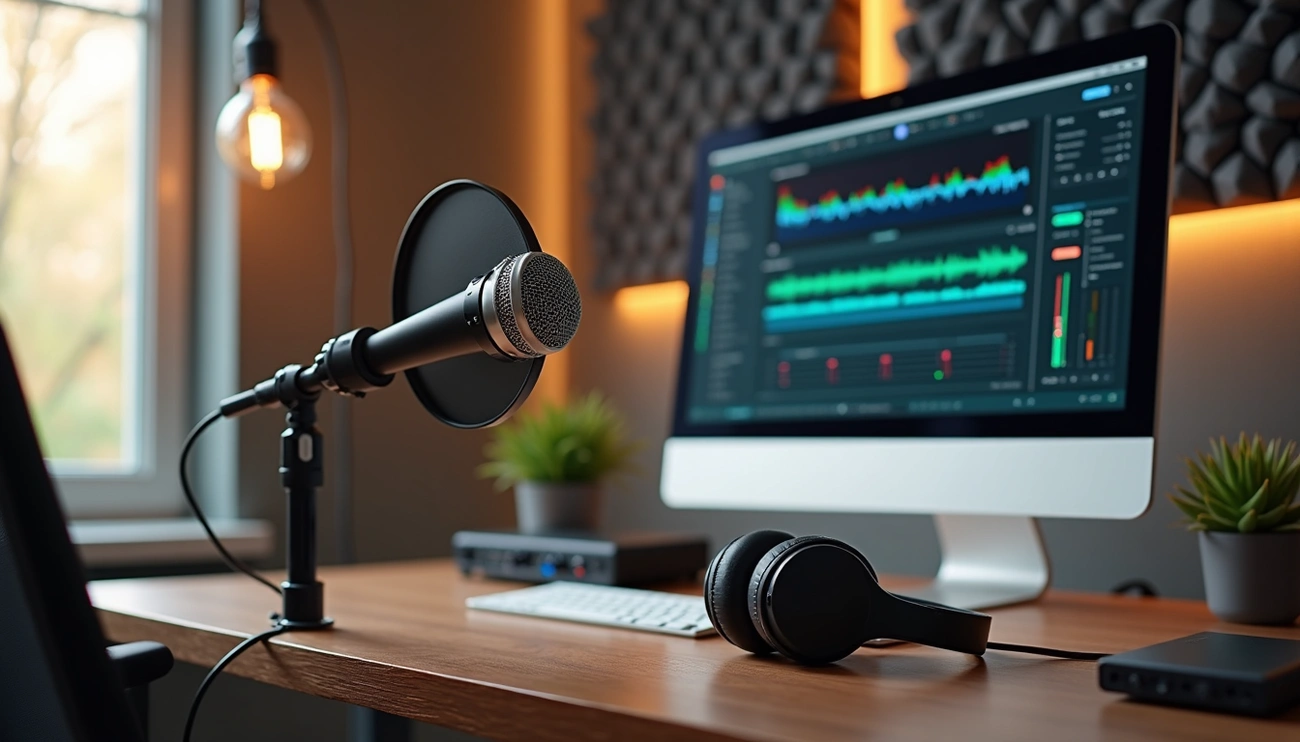
Your podcast recordings sound good, but they don’t have that polished, studio-quality finish yet. The difference? Proper mastering tips can revolutionize your audio from amateur to professional.
Here’s the thing: getting quality audio is easier and cheaper than ever, so you can achieve studio-level results even with simple equipment. But mastering remains the secret ingredient that separates great podcasts from average ones.
In this piece, we’ll walk you through audio mastering tips, mixing and mastering tips, and home mastering tips that will lift your podcast sound. These music mastering tips and tricks will help you create polished episodes, covering compression techniques and loudness standards.
Ready to master your podcast like a pro? Let’s get started!
Understanding Podcast Mastering Fundamentals
What is Podcast Mastering
Mastering serves as the final step when you prepare your podcast audio for distribution. Most podcast recordings have just a few tracks, so mastering often has mixing. Music production might handle 20 or more tracks, but podcast sessions are simple. That’s why these processes often happen together.
The mastering process wants to clean your recording from unwanted sounds and background noise. It attenuates unpleasant voice features and improves important speech frequencies. Voices get compressed to sound coherent. Loudness becomes normalized, and volume transitions throughout the mix stay smooth. Your podcast also has musical elements like intro, outro and segment transitions that need mastering attention.
Why Mastering Matters for Your Podcast
Mastering builds trust and protects your brand. Poor audio quality influences how listeners notice your credibility, according to research on audio quality and speaker perception. Listeners notice volume inconsistencies, background noise, muffled voices and distracting distortions when your audio lacks professional mastering.
Proper mastering creates consistency across episodes and reduces listener fatigue through controlled volume levels. It optimizes playback across different devices. Each voice requires individual processing because every speaker has unique frequency characteristics.
Mastering vs Mixing: Main Differences
Mixing balances individual tracks in your session. Mastering finalizes the mixed stereo track for distribution. Mixing handles all the big adjustments on separate tracks. Mastering works with everything as a combined file.
Mixing represents 80% of your sound. Mastering accounts for the remaining 20%. The mixing phase sets levels between tracks and applies EQ and compression to individual elements. Mastering makes subtle broad strokes that affect the entire episode. This stage is not the time for drastic changes.
Setting Up Your Mastering Workflow
Start with professional cleaning and preparation by removing accidental sounds. Split speakers recorded on a single track to give each voice its own separate track for individual processing.
Your target loudness should range from -18 LUFS to -15 LUFS. Many engineers think -16 LUFS is the perfect integrated loudness for podcasts. Mono episodes should aim for -19 LUFS. Stereo episodes should target -16 LUFS. Add brickwall limiting to -6 dB or -3 dB at the end to catch any missed peaks.
Essential Audio Mastering Tools and Techniques
Equalization for Clarity and Balance
Apply a high-pass filter at 80-100 Hz to remove low-frequency rumble, bumps and plosives that add no value to voice recordings. The human voice doesn’t go lower than this point, so cutting these frequencies cleans your audio without affecting vocal warmth.
Reduce frequencies between 150-300 Hz to minimize muddy or boomy sounds, especially in male voices. To name just one example, when balancing male and female speakers, cutting this range on the male voice helps even out perceived loudness. Boost the 2-3 kHz range to add clarity and presence, as human ears evolved to be most sensitive to these speech frequencies. Control sibilance by reducing 5-8 kHz, though a dedicated de-esser works better for harsh “s” and “sh” sounds.
Compression for Consistent Loudness
Compression tames peaks in your waveform and reduces dynamic range. Loud parts become closer in volume to quiet parts. Set your threshold where the compressor starts working, just above your average signal level. Use ratios between 1.5:1 and 4:1 for podcast voices, with 2:1 being a common default. A 4:1 ratio means for every 4 decibels louder the audio gets above threshold, it only increases by 1 decibel.
So your file becomes quieter after compression. Apply makeup gain to restore proper levels without manual readjustment.
Limiting to Prevent Clipping
Limiters are compressors with instant attack and high ratios (10:1 to infinity:1) that stop audio peaks from exceeding a maximum level. Digital clipping causes awful distortion, so limiting keeps peaks below your ceiling. Set your true peak value not exceeding -1 dBFS to prevent intersample peaks and codec artifacts.
Stereo Enhancement Techniques
Stereo enhancement rarely applies to podcast production, as most shows use mono or simple stereo voice tracks. But if you need to widen stereo music beds, use stereo imaging plugins to adjust phase and amplitude relationships between left and right channels.
Loudness Normalization Standards
The podcast industry standardized on -16 LUFS integrated loudness. This measurement reflects how loud audio sounds to human ears over the entire file. Apple Podcasts requests -16 dB LKFS with a ±1 dB tolerance, giving you a working range of -17 to -15 LUFS. Most DAWs include loudness normalization features that adjust your file to hit this target during export.
Mixing and Mastering Tips for Professional Sound
Balancing Voice and Music Elements
Create your foundation using the host or reporter track first. Balance each audio clip to match the preceding one. Make sure ambience and music remain audible without competing. Mix tracks from top down: start with host tracks, then actualities and guest audio, followed by ambience and music.
Use the “rock and roll” mixing trick to judge ambience and music levels. Listen on both headphones and speakers, as balance sounds different on each playback system. A compromise between these two options works well in most situations.
Removing Unwanted Frequencies
Solo each track and insert an EQ plugin to identify tonal issues like rumble, hollowness, or harshness. Hunt for problem frequencies and reduce them with precision rather than using broad cuts. For constant high-frequency noise, locate the specific frequency and use a narrow parametric EQ cut instead of a low-pass filter that deadens your whole track.
Applying Subtle Reverb and Effects
Set up reverb on auxiliary sends using post-fade routing so send levels don’t affect overall track volume. Pick presets based on the space you want your mix to inhabit rather than preset names. Avoid reverbs with prominent frequency extremes, as high frequencies make reverb too audible and low frequencies reduce punch.
Before reverb, use a high-pass filter at 600 Hz to manage low-end muddiness. Balance dry and wet signals with care, as too much reverb creates mud while too little sounds flat.
Creating Depth in Your Mix
Volume serves as the most obvious depth tool: louder elements appear closer, softer elements seem distant. Reverb can push sounds back in the mix, but use it with restraint in busy productions to avoid muddiness. Roll off high frequencies to make elements sound further away, as highs dissipate over distance in natural acoustics.
These three techniques work together for precise placement: adjust volume for positioning, then add reverb for spatial character and use EQ to refine the depth perception.
Managing Dynamic Range
Dynamic range describes the span between softest and loudest sounds in your recording. Natural speech has volume changes that add expression, but extreme variations force listeners to adjust their playback level constantly.
Layer compression in series rather than applying heavy processing from a single compressor. Start with a soft-knee 2:1 ratio with fast attack and slow release. This triggers gain reduction to even out medium-term variations. A second, higher-ratio compressor using faster release should follow to catch individual loud syllables.
Home Mastering Tips: Quality Control and Final Steps
Reference Tracks to Compare
You navigate blind when you master without reference tracks. Choose two or three professionally mastered podcasts in your genre with similar instrumentation. Import them into your DAW and level match them to your mix before you compare, as louder audio creates the illusion of better tonal balance. Focus on how frequency ranges sit: is the low-end tight, are mids balanced, do highs sound crisp? Reference tracks accelerate your mastering skills by letting you compare yourself to industry standards immediately.
Testing on Multiple Playback Systems
Your mastered episode needs testing outside your working environment at least once. Car stereo and cheap earbuds reveal different issues. Cars expose deficiencies in low-end sustain, while phone speakers strip away sub bass and reveal harshness in upper midrange. Headphones excel at revealing micro details like harsh consonants and reverb tails.
Exporting in the Right Format
MP3 at 128 kbps or less offers optimal streaming balance between quality and file size. Use constant bit rate (CBR), 44.1 kHz sample rate, and 32-bit float or 24-bit depth. Target -16 LUFS for stereo episodes.
Common Mastering Mistakes to Avoid
You get inconsistent results when you skip reference tracks. Loudness pushed too far causes distortion and listener fatigue.
When to Think About Professional Mastering
Professional mastering provides outside point of view, fresh ears, and extensive experience you can’t replicate yourself. A mastering engineer becomes necessary when home results don’t match your goals.
Conclusion
You now have everything you need to achieve mastery over your podcast episodes and get that studio-quality sound. Note that mastering takes practice and patience, so don’t expect perfection on your first try.
Implement these audio mastering tips on your next episode. Test your results on multiple devices and compare against professional podcasts. Refine your approach with each release. Your listeners will notice the difference, and your podcast will stand out.